
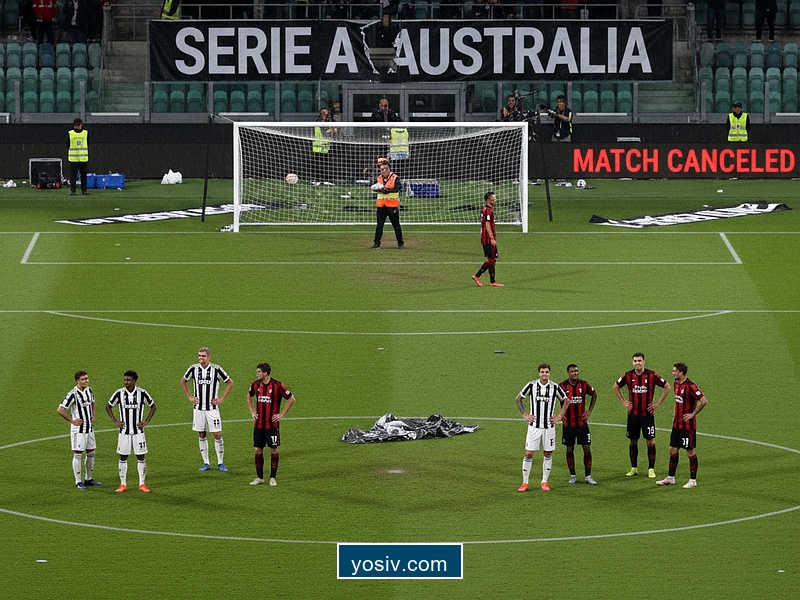
If you watch the tape closely, the breakdown didn't happen when the press release dropped. In scouting, we look for the "tell" long before the player makes the mistake—a drop of the shoulder, a hesitation in the stride, a glance at the bench. The cancellation of the proposed Serie A fixture in Australia wasn’t just a logistical hiccup; it was a fundamental failure of technical execution and spatial awareness by the league's hierarchy. They tried to force a pass through a corridor that didn't exist.
To the untrained eye, this is a story about travel agents and scheduling conflicts. To a scout analyzing the movements of modern football administration, this is a team stretching its shape until it snaps. Serie A is currently playing a desperate high line, trying to catch the Premier League offside in the race for global revenue, but they lack the recovery pace to handle the counter-attack. This Australian venture was a reckless overlap, leaving the defense—the players and the domestic product—completely exposed.
The Physiology of a Bad Deal
Let’s look at the biomechanics of this decision. The proposal involved shipping elite squads to the Southern Hemisphere immediately following a grueling 38-game domestic season and deep European runs. In coaching terms, this ignores all principles of tactical periodization.
You cannot demand high-intensity output (marketing visibility, commercial activation) when the biological battery is in the red zone. The players, represented by the AIC (Associazione Italiana Calciatori), have been signaling heavy legs for years. The connective tissue of the sport—the relationship between labor and management—is inflamed.
"It is the administrative equivalent of playing a box-to-box midfielder for 90 minutes three times a week and acting surprised when his hamstring goes. The league creates the fixture congestion, then tries to sell the fatigue as a premium product."
The "complications" cited in the cancellation aren't random variables; they are the result of poor load management. You don’t schedule a high-profile friendly or competitive exhibition in Perth when the calendar is already compressed by expanded UEFA formats and FIFA’s bloated Club World Cup ambitions. The movement patterns here are sluggish. The executives are reacting to financial pressure rather than anticipating logistical reality.
Scanning the Field: The "39th Game" Obsession
Historically, this movement pattern isn't new, which makes the error even more egregious. We saw the Premier League attempt this tactical shift in 2008 with Richard Scudamore’s "39th Game" concept. It was scouted, analyzed, and rejected by the global football community because it broke the competitive integrity of the round-robin format. Serie A, however, keeps trying to execute this play despite seeing it fail for others.
We’ve seen the Supercoppa Italiana moved to Saudi Arabia. That’s a set-piece play—a one-off event in a controlled environment for a cash injection. It’s cynical, but tactically sound from a revenue perspective. Moving a match or a post-season tour to Australia is open-play chaos. The distance, the time zone difference (AWST is 6 hours ahead of CET), and the acclimatization period required for elite performance make the "pitch" unplayable.
The league is trying to utilize the "half-spaces" of the global market—areas where the Premier League hasn't fully saturated interest. Australia has a massive Italian diaspora; on paper, the xG (Expected Goals) for this marketing move looked high. But football isn't played on a spreadsheet. By failing to secure the logistics early, Serie A showed they lack the technical quality to control the ball in tight spaces.
The Unseen Work: Promoting vs. Developing
A good scout watches what a player does when they don't have the ball. What is Serie A doing off the ball? Right now, they are chasing shadows.
The cancellation reveals a lack of structural support. The promoters involved in these tours are often third-party agencies operating with thin margins. When Serie A outsources its brand to external promoters without rigid guarantees, they are essentially playing with a high defensive line and no goalkeeper. If the promoter slips (funding issues, venue availability), the goal is empty. The integrity of the brand takes the hit.
Furthermore, the "opposition scout" report—in this case, the analysis of the Australian market—was flawed. Australian football fans are sophisticated. They know the difference between a competitive fixture and a glorified training session played at 60% intensity by reserves because the stars are protecting themselves for the Euros or Copa America. You cannot fool the crowd with a low-block, defensive display disguised as a spectacle.
Tactical Rigidity in the Boardroom
The breakdown in Australia is symptomatic of a league that refuses to modernize its internal build-up play while obsessing over the final third (revenue). Serie A’s TV rights cycle is a constant battle for survival. They are losing ground to the Bundesliga and La Liga in international rights value.
Instead of fixing the academy system, upgrading crumbling stadiums (the infrastructure is akin to playing on a mud bath), or improving the broadcast product's visual quality, the executives attempt these "Hail Mary" long balls to foreign markets. It is low-percentage football. It reeks of panic.
| Attribute | Rating (1-10) | Notes |
|---|---|---|
| Vision | 4 | Sees the open space (global markets) but fails to execute the pass. |
| Agility | 2 | Slow to react to logistical hurdles; turns like an ocean liner. |
| Technique | 5 | Can organize the Supercoppa, but fails in complex tour logistics. |
| Work Rate | 8 | High effort in seeking revenue, but often runs down blind alleys. |
The Locker Room Atmosphere
We also need to assess the body language of the managers and players involved. When these tours are announced, look at the press conferences. The smiles are tight; the answers are rehearsed. Stefano Pioli (when he was at Milan) or Daniele De Rossi speak about "opportunities," but their eyes tell you they are dreading the flight. They know this disrupts the micro-cycles of training and recovery.
A team that doesn't believe in the game plan will eventually stop running. By constantly forcing these logistical nightmares, the league risks losing the dressing room. Players are becoming more empowered. They are tracking their own data. They know when their load is too high, and they are beginning to refuse these call-ups. The cancellation might be listed as "complications," but read between the lines: it’s likely a player revolt in disguise.
Final Verdict
This canceled trip is a tactical foul that stopped a promising attack, but the referee (the market) isn't fooled. Serie A needs to stop looking for shortcuts. You cannot build a global powerhouse by dragging exhausted squads across the globe for meaningless friendlies that fall apart at the negotiation table.
The league needs to return to fundamentals. Compact the shape, secure the domestic foundations, and only expand when the transition game is sharp enough to handle the pressure. Right now, Serie A is trying to play Champions League football with Sunday League administration.