
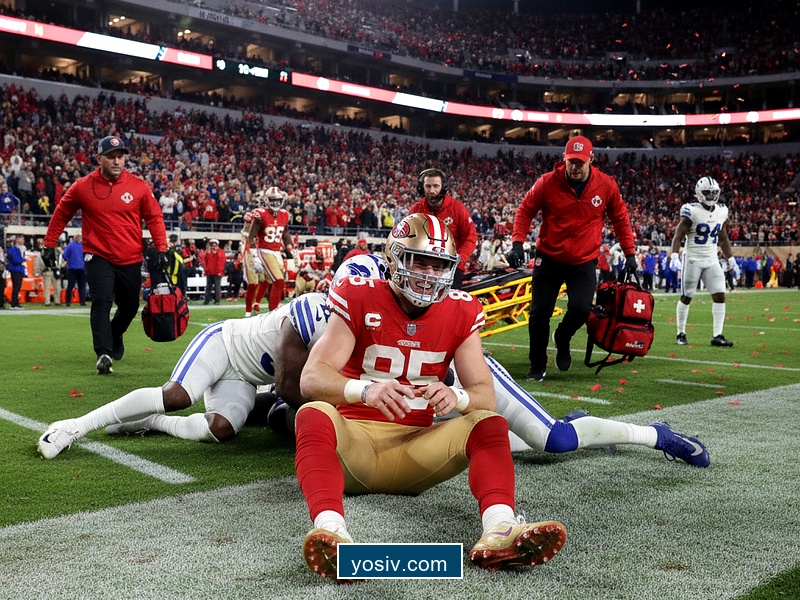
The image of George Kittle limping toward the locker room during the victory over the Indianapolis Colts wasn't just a concern for the fantasy football community; it was a tremor running through the foundation of the San Francisco 49ers' championship architecture. While Kittle himself downplayed the severity—stating he doesn't believe it to be a high ankle sprain—the mechanism of injury tells a darker, more complex story about the modern NFL and the physical price of Kyle Shanahan’s offensive genius.
Kittle was brought down by a "hip-drop" tackle, a maneuver that has become the scourge of offensive skill players and a focal point of intense competition committee debate. When a defender wraps the waist and drops their dead weight onto the runner’s legs, the torque on the ankle and knee is catastrophic. Kittle’s optimism is characteristic of his wrestling background, but mechanics rarely lie. Even if he avoids the dreaded "high ankle" designation, the inflammation and limited mobility put his availability for the upcoming Chicago Bears matchup in serious jeopardy.
The Ghost of Rob Gronkowski
To understand the gravity of a compromised George Kittle, we must look back a decade to the only other tight end who rivaled his combination of blocking violence and receiving prowess: Rob Gronkowski.
Between 2011 and 2015, Gronkowski was the most dominant force in football. He was also a walking casualty ward. Why? Because, like Kittle, he was too big for defensive backs to tackle high and too fast for linebackers to cover in space. Defenders resorted to diving at his knees or, in the era before the hip-drop terminology took hold, dragging him down by collapsing on his legs.
In 2012, Gronkowski broke his forearm blocking on an extra point, returned, and then reinjured it. The following year, T.J. Ward ended Gronk's season with a low hit that shredded his ACL and MCL. The parallel here is terrifying for the 49ers faithful. Kittle plays with that same reckless abandonment—a style that demands he act as an offensive tackle one play and a wide receiver the next. The human body has a breaking point, and the hip-drop tackle is designed to find it.
"I got hurt on a hip-drop tackle... I don’t think it’s a high ankle sprain. We’ll see." — George Kittle, via NBC Sports
Tactical Fallout: The Shanahan Engine
If Kittle misses time, the drop-off is not merely statistical; it is structural. In the mid-2000s, when the Indianapolis Colts lost Dallas Clark, Peyton Manning lost a safety valve. But when the 49ers lose Kittle, they lose their run game coordinator.
Shanahan’s "wide zone" offense is predicated on the tight end’s ability to seal the edge against defensive ends. This isn't the finesse blocking of the Tony Gonzalez era. This is trench warfare. Kittle is often asked to block a 270-pound defensive end 1-on-1, allowing Christian McCaffrey to cut back. If a backup tight end steps in—someone like Eric Saubert—defensive coordinators instantly stop respecting the edge. They crash the B-gaps. The geometry of the offense collapses.
The Evolution of Tight End Attrition
We are witnessing a historical cycle repeat itself. In 2005, the NFL banned the "horse-collar" tackle after Roy Williams broke Terrell Owens' ankle and Musa Smith’s leg. The league recognized a specific mechanical movement was causing disproportionate injury. The hip-drop is the horse-collar of the 2020s.
| Era | Dominant TE Prototype | Primary Defensive Threat | Legislative Outcome |
|---|---|---|---|
| 2000-2005 | Tony Gonzalez / Antonio Gates | Head-hunting safeties over the middle. | Defenseless receiver rules expanded. |
| 2010-2015 | Rob Gronkowski / Jimmy Graham | Low hits (ACL/MCL targeting). | Rules protecting knees on passing plays. |
| 2020-2025 | George Kittle / Travis Kelce | The Hip-Drop Tackle (Torque on ankles). | Pending/Active league bans and fines. |
The Bears Loom: A Trap Game Scenario
The timing could not be worse. The upcoming game against the Chicago Bears presents a unique challenge. While Chicago has struggled with consistency, their defensive front is athletic. Without Kittle to neutralize the edge rushers or provide that reliable outlet over the middle, Brock Purdy loses his security blanket. This mirrors the struggles the late-career Brady Patriots had when Gronkowski was shelved; the offense became horizontal, predictable, and brittle.
If Kittle cannot go, Shanahan must alter his personality. He cannot run the same outside zone concepts. He has to pivot to a quick-game, spread offense that exposes his offensive line's pass-blocking deficiencies—deficiencies Kittle usually masks with his chipping and presence.
The Verdict
This injury is a microcosm of the 49ers' current existence. They are a Ferrari engine inside a chassis that has 200,000 miles on it. They are talented, explosive, and perpetually one awkward tackle away from disaster. The hip-drop tackle that caught Kittle’s ankle is a reminder that in the NFL, legislation always lags behind innovation. Defenders found a way to stop the unstoppable force, but the collateral damage is the health of the league's brightest stars.
Whether it is a high ankle sprain or a severe bone bruise is almost irrelevant. The wear and tear are cumulative. Kittle is 31 years old. In tight end years—especially for those who block like offensive linemen—that is effectively geriatric. Mark Bavaro, the toughest tight end of the 1980s, was essentially finished by age 29 due to knee issues. Kittle is fighting history as much as he is fighting opposing linebackers.
San Francisco escaped the Colts game with a win, but if Kittle is compromised for an extended stretch, the ceiling of this offense lowers dramatically. You cannot replace a Hall of Fame trajectory player with a "next man up" mentality. You simply survive, and hope the attrition doesn't swallow you whole before January.