
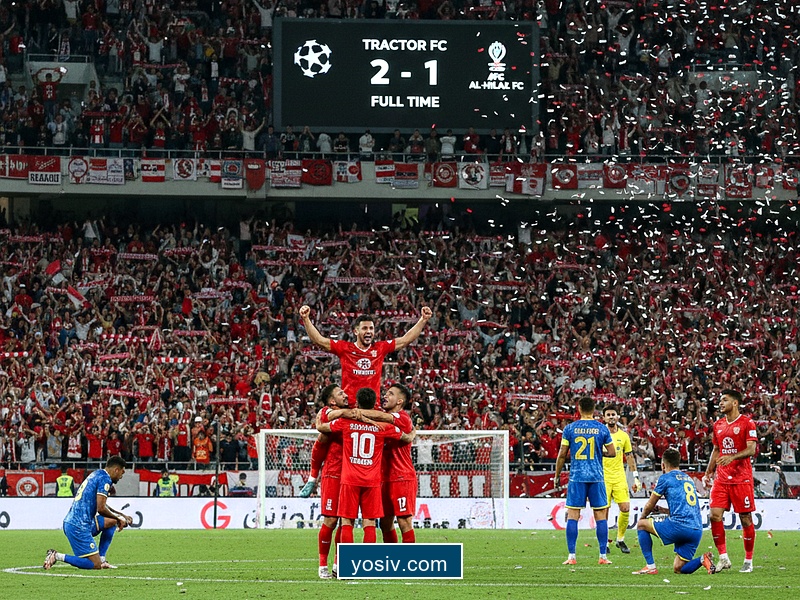
There is a specific kind of fatalism that usually plagues Iranian clubs outside of Tehran when they step onto the Asian stage. It is a mixture of awe, tactical naivety, and the crushing weight of trying to outshine the capital’s giants, Persepolis and Esteghlal. But watching Tractor SC dismantle their opposition to book a spot in the AFC Champions League Elite Round of 16, that fatalism was notably absent. Instead, we saw something rare: ruthless, cold-blooded efficiency.
The headline from the Tehran Times will tell you they qualified. It won’t tell you that this is the most significant tactical shift in Iranian club football since Sepahan’s miracle run to the AFC Champions League final in 2007. For two decades, the narrative has been that provincial teams provide the passion, while Tehran provides the silverware. Tractor, under the stewardship of the vindicated Dragan Skočić, is torching that script.
The Croatian Connection: Skočić vs. Bonačić
To understand the magnitude of what is happening in Tabriz, you cannot look at this team in a vacuum. You must look back 17 years to the last time a non-Tehran team truly threatened the Asian order. The 2007 Sepahan side, led by Luka Bonačić, was a team built on defensive granite and counter-attacking poison. They reached the final against Urawa Red Diamonds and qualified for the FIFA Club World Cup.
Dragan Skočić is channeling the spirit of that 2007 era, but with a modern, fluid twist. Both coaches are Croatian, a nationality that has arguably done more for Iranian football infrastructure than any other. However, where Bonačić was an authoritarian pragmatist who favored a rigid low block, Skočić is a tactical chameleon.
Skočić arrived in Tabriz with a chip on his shoulder the size of the Zagros Mountains. Unceremoniously sacked from the Iranian National Team despite the fastest qualification in Asian history (15 wins in 18 games), he is using Tractor as the vehicle for his reputation rehabilitation. He has instilled a positional discipline that was sorely lacking during the chaotic, albeit romantic, Toni Oliveira years of the early 2010s.
"This isn't the 'hit-and-hope' football of the past decade where Iranian clubs relied on physical attrition. Skočić has Tractor playing in the half-spaces, a tactical sophistication usually reserved for the J-League or Saudi heavyweights."
The Engine Room: Alves is the New Navidkia
Every great Iranian side has a metronome. In the mid-2000s, Moharram Navidkia was the brain of Sepahan. He didn’t run much, but he saw passing lanes before they existed. He was the architect of the 2007 run. For years, pundits have lamented the death of the classic "number 10" in the Persian Gulf Pro League, citing the shift toward physical defensive midfielders.
Enter Ricardo Alves. The Portuguese playmaker is not just statistically impressive; he is the spiritual successor to Navidkia. In the match that sealed their qualification, Alves didn’t just distribute; he dictated the tempo of the opposition. His ability to deliver dead balls is currently unmatched in West Asia. Where the Tractor teams of 2013-2016 would panic under high pressing from Qatari or Saudi sides, Alves provides a release valve that allows the team to retain possession under duress.
The difference is the supporting cast. Navidkia often had to carry the creative burden alone. Alves is flanked by the resurgence of Amirhossein Hosseinzadeh. Watching Hosseinzadeh play in this tournament recalls the prime years of Arash Borhani—not necessarily in style, but in the "clutch" factor. Borhani was often criticized for missing sitters, but he scored when it mattered. Hosseinzadeh has refined that chaos. He is clinical, drifting wide and cutting inside, exploiting the space created by Alves’s vision.
Structural Integrity: The End of the "Red Wolves" Chaos
The Yadegar-e Emam Stadium is famous for the "Red Wolves," a fan base that rivals anything in Turkey or South America. However, that passion has historically been a double-edged sword. Previous iterations of Tractor fed off the crowd’s energy, leading to frenetic, emotionally charged performances that collapsed when tactical discipline was required. They would attack blindly, leaving the back door open.
Skočić has seemingly severed the emotional link between the stands and the tactical setup. The team plays with an ice-cold demeanor. This is evident in the defensive pairing anchored by Shoja Khalilzadeh. Comparing him to the legends of the past, he operates with the aerial dominance of a prime Jalal Hosseini but with better distribution.
The table below highlights the shift in philosophy between the "Almost" era of Tractor and the current machine:
| Metric | Tractor (Oliveira Era 2013-14) | Tractor (Skočić Era 2024-25) |
|---|---|---|
| Tactical Shape | Rigid 4-4-2 / Emotional Pressing | Fluid 4-3-3 / Triggered Pressing |
| Possession vs Top Tier | 35-40% (Counter-attack reliance) | 50-55% (Control focused) |
| Playmaker Archetype | Ali Karimi (Individual brilliance) | Ricardo Alves (Systemic creator) |
| Defensive Transition | High Risk / Exposed | Compact Mid-Block |
The AFC Elite Context: Why This Time is Different
We must also acknowledge the battlefield. The transition to the AFC Champions League Elite format changes the mathematics of survival. The old system was a knockout roulette that favored teams with historical pedigree and vast experience. The new league format rewards consistency and squad depth—two things Tractor has quietly accumulated while the Tehran giants squabbled over financial mismanagement and boardroom politics.
Furthermore, the elimination of the away goals rule and the restructuring of the foreign player quota have leveled the playing field for Iranian clubs, provided they recruit well. Tractor’s recruitment has been surgical. While other clubs chased fading stars for marketing clout, Tractor signed players specifically to fit Skočić’s high-octane system.
This qualification isn't just about making the Round of 16. It is a signal that the center of gravity in Iranian football is shifting. For two decades, the national team’s spine was formed in Tehran. Now, with Khalilzadeh at the back and Hosseinzadeh up front, Tabriz is demanding representation.
A Warning to the West Zone
The skeptics will point to the immense spending power of the Saudi Pro League clubs. They will say that Tractor’s run will end the moment they face Al-Hilal or Al-Nassr. Perhaps. But looking back at 2007, Sepahan didn’t have the budget of Urawa Red Diamonds or Al-Wahda. They had a system, a Croatian tactician who knew how to nullify stars, and a playmaker who could thread a needle from 40 yards.
Tractor has all those components today. They have shed the label of the "passionate underdogs." They are no longer happy just to be invited to the party. Skočić is a man with a point to prove, managing a club that feels it has been denied its rightful place at the high table for too long.
The Round of 16 is not the ceiling for this squad; it is the baseline expectation. If they can maintain the composure shown in the group stages, we are not just looking at a participant. We are looking at the first Iranian side outside of Tehran to genuinely threaten the Asian trophy since the golden days of Sepahan. The Red Wolves have stopped howling at the moon and started hunting.