
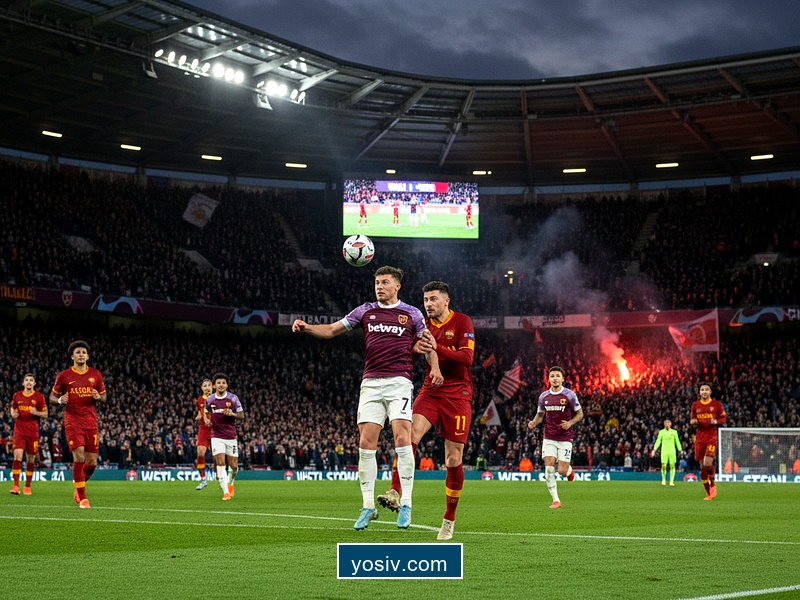
The rumor mill is rarely a place for nuance, but the noise surrounding West Ham United’s pursuit of Roma’s Artem Dovbyk feels different. This isn't the scattergun approach of the Sullivan era, nor is it the bargain-bin hunting that characterized the leaner years at the London Stadium. If the reports from Yahoo Sports are accurate and the Hammers are indeed leading the race for the Ukrainian marksman, we are witnessing the final death knell of "Moyes-ball" and the true beginning of the Julen Lopetegui project.
To understand why this transfer matters, one must look past the YouTube highlight reels of Dovbyk’s left foot. This potential acquisition is not about goal volume—though that helps. It is a fundamental philosophical stake in the ground. It is an admission that to play the brand of football Lopetegui demands, the brooding, chaotic physicality of Michail Antonio is no longer sufficient. West Ham is attempting to trade chaos for control.
The Sevilla Blueprint: Why the Number Nine Matters
Julen Lopetegui has never been a manager who enjoys anarchy. His best work, specifically the Europa League-winning tenure at Sevilla, was built on a rigid, almost suffocating possession structure. He craves a team that moves as a synchronized unit, suffocating opponents in their own third and recycling possession until a fissure appears in the defensive block.
In that system, the striker is not merely a finisher; they are the fulcrum. At Sevilla, Youssef En-Nesyri was crucial not just because he scored, but because he offered a specific verticality that stretched defenses without sacrificing technical link-up. The striker in a Lopetegui 4-3-3 or 4-2-3-1 must have the touch of a midfielder and the presence of a bouncer.
"Lopetegui does not want a striker who chases lost causes into the channels. He wants a striker who anchors the center-backs, allowing the inverted wingers and overlapping full-backs to overload the half-spaces."
This is where the Dovbyk profile becomes fascinating. During his Pichichi-winning season at Girona in 2023/24, where he netted 24 goals, Dovbyk was a monster of efficiency. But statistically, his most impressive metric was his ability to receive the ball under pressure with his back to goal and lay it off cleanly to onrushing midfielders like Aleix García or Yangel Herrera. He is a platform player.
Compare this to West Ham’s current reality. For years, the Hammers’ attack has been predicated on the ball being cleared into the atmosphere, with Antonio wrestling two center-backs while Jarrod Bowen sprints 40 yards to support. It was effective, but it was primitive. Lopetegui’s football requires the ball to stay on the carpet. Dovbyk represents the bridge between a midfield that wants to play technically—think Lucas Paquetá and Mohammed Kudus—and a final third that actually retains possession.
The Girona Context: A Tactical Mirror
To understand the logic of this transfer, we must revisit Michel’s Girona side that took La Liga by storm. That team functioned on rapid transitions that morphed into settled possession—a hybrid style that suits the Premier League’s current meta. Dovbyk thrived there because he wasn't asked to do everything. He was asked to dominate the penalty box.
At Roma, the fit has been awkward. Serie A defenses sit deeper, and the tactical rigidity of Italian football often isolates strikers who aren't getting quick service. If West Ham can replicate the service lines Dovbyk enjoyed in Catalonia—specifically via cutbacks from the byline—he becomes a lethal asset.
However, the real information gain here is looking at the types of goals he scores. A massive percentage of his Girona goals came from inside the six-yard box via one-touch finishes. This implies that for Dovbyk to work at West Ham, Lopetegui must solve the creativity issue first. The manager's reliance on full-backs pushing high (Emerson Palmieri and Aaron Wan-Bissaka) is designed to create those exact cutback scenarios. The signing of Dovbyk would validate Lopetegui’s insistence on high full-backs, proving that the system is designed to feed a poacher, not a channel-runner.
Tim Steidten and the Friction of Evolution
We cannot analyze this move without acknowledging the architect in the shadows: Tim Steidten. The Technical Director’s influence at West Ham has grown, creating a fascinating tension between data-driven recruitment and managerial preference. Dovbyk feels like a Steidten pick—a player whose underlying numbers (xG overperformance, shot volume inside the box) scream "undervalued asset" despite a potentially rocky start in Rome.
This signals a shift in West Ham’s sustainability model. Historically, the club bought Premier League veterans with low ceilings (Danny Ings) or took punts on unproven leagues. Targeting a player who has dominated a top-five league recently suggests an ambition to raise the technical floor of the squad immediately. It is an expensive gamble, but one necessitated by the aging curve of the current roster.
| Attribute | The Moyes Era (Antonio) | The Lopetegui Target (Dovbyk) |
|---|---|---|
| Primary Function | Channel running, physical disruption | Box occupation, link-up play |
| Ball Retention | Low (High risk/reward) | High (Possession recycling) |
| Positioning | Drifting wide to drag defenders | Central anchor to pin defenders |
| Service Required | Long balls, chaos | Cutbacks, through balls |
The Danger of the "System" Striker
There is, naturally, a caveat. Lopetegui’s system can often become sterile. We saw it at Wolves; we saw it at the end of his Sevilla reign. Possession can become an end unto itself, forming the dreaded "horseshoe" of passing around the opposition box without penetration. A striker like Dovbyk can become isolated in such a system if the tempo is too slow. He is not a creator; he is a finisher. If Paquetá is off form or if the wingers are too static, Dovbyk will look pedestrian.
Furthermore, the Premier League is unforgiving to strikers who lack elite pace. Dovbyk is quick enough once he gets going, but he does not possess the explosive acceleration of an Ollie Watkins or the raw power of Erling Haaland. He relies on intelligence and positioning. Lopetegui is betting that his system can create the space Dovbyk needs, rather than asking Dovbyk to create space for the system.
A Paradigm Shift in East London
West Ham stands at a crossroads. The transition from a counter-attacking underdog to a possession-dominant protagonist is the hardest leap a football club can make. It usually results in a season or two of mid-table mediocrity as the muscle memory of the squad is rewritten.
Pursuing Artem Dovbyk is a declaration that the club is committed to this painful evolution. It is a rejection of the "get it forward" mentality that has defined the club's identity for the better part of a decade. If Steidten lands this deal, he is handing Lopetegui the final piece of the puzzle.
The manager will then have no excuses. He will have his anchor, his finisher, and his platform. If West Ham fails to control games with a player of Dovbyk’s technical security leading the line, the failure will lie not in the recruitment, but in the dugout. This isn't just a transfer rumor; it is the moment the Lopetegui era truly begins—or begins to unravel.