
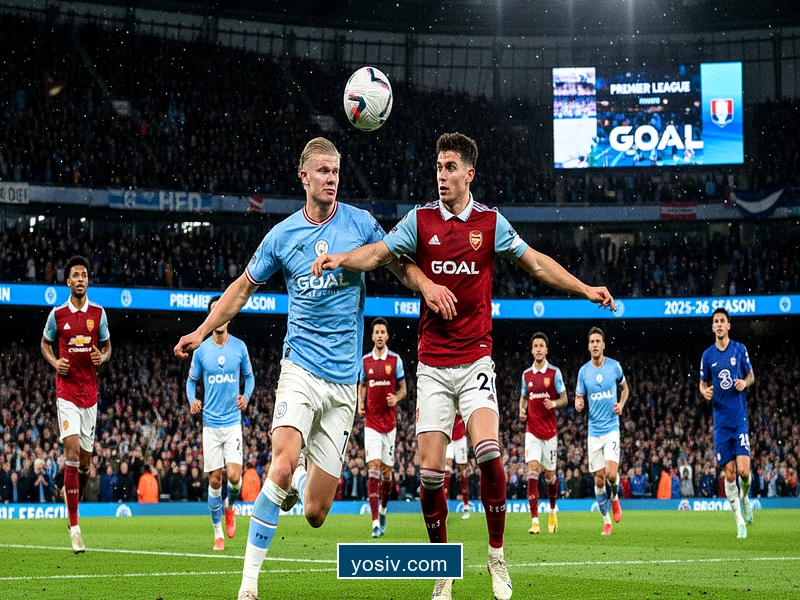
The release of GOAL's Premier League Team of the 2025-26 Season so far offers more than just a list of high-performing millionaires; it serves as a litmus test for the tactical evolution of English football. We are currently witnessing a fascinating paradox. While the game has become obsessed with inverted full-backs, box midfields, and algorithmic pressing triggers, the two names anchoring this list—Erling Haaland and Declan Rice—represent a return to the heroic individualism of the mid-2000s. They are modern avatars of a bygone era, polished by Guardiola-ism but forged in the fires of old-school dominance.
Twenty years ago, during the 2005-06 season, Jose Mourinho’s Chelsea was dismantling the league with ruthless efficiency, while Arsenal was coming to terms with the twilight of the Invincibles. Looking at Haaland and Rice today, I don't see the "false nines" or "double pivots" that defined the 2010s. I see the ghosts of Ruud van Nistelrooy and Patrick Vieira, reanimated and upgraded for the high-press era. This team of the season isn't just about stats; it is about the re-emergence of physical intimidation as the premier currency of the league.
The Haaland Singularity vs. The Van Nistelrooy Obsession
Erling Haaland’s inclusion is inevitable, bordering on boring, until you strip away the goal tally and look at the methodology. For a decade, between 2010 and 2020, the Premier League fetishized the creative forward—the Roberto Firminos and Harry Kanes who dropped deep to facilitate. Haaland has killed that trend. He is the ultimate rebuke to the idea that a striker must touch the ball 50 times a game to be effective.
To find his true predecessor, we must look back to the 2002-2006 window and Manchester United’s Ruud van Nistelrooy. The Dutchman was famously allergic to scoring from outside the box; he was a specialist in spatial economy. Haaland shares this obsession. However, where Van Nistelrooy was a surgeon, Haaland is a natural disaster.
"We spent ten years teaching strikers to be midfielders. Haaland arrived and reminded everyone that the most dangerous place on the pitch is the six-yard box, and the most dangerous trait is not passing, but inevitability."
The tactical shift here is profound. In 2005, defenders like Rio Ferdinand and John Terry could engage in a physical wrestle with a striker. They enjoyed it. Today’s center-backs, groomed in academies to be ball-playing quarterbacks (think of the Saliba or Stones archetypes), are ill-equipped to handle a forward who treats contact not as a foul, but as a leverage point. Haaland exploits the "non-contact" evolution of defending. He brings the brute force of 2005 Didier Drogba to a league that has forgotten how to defend against it.
| Attribute | Ruud van Nistelrooy (2003 Era) | Erling Haaland (2025 Era) |
|---|---|---|
| Primary Zone | The Penalty Spot (Poacher) | The Channels & Six-Yard Box (Hybrid) |
| Physicality | Hold-up play with back to goal | Transition speed facing goal |
| Psychological Impact | Frustration | Terror |
Declan Rice: The Modern Vieira
If Haaland is the hammer, Declan Rice is the anvil. seeing him anchor the Team of the Season validates his transformation from a promising holder to a total midfielder. The lazy comparison for Rice has always been Roy Keane, but that ignores Rice’s ball-carrying biomechanics. Watch the way Rice eats up ground at the Emirates or the Etihad; the long stride, the chest-out drive through the center circle. That is not Keane. That is Patrick Vieira.
In the 2004-05 season, Vieira (in his final year at Arsenal) and Chelsea’s Claude Makélélé were the two poles of midfield play. Makélélé was the pure destroyer, sitting deep, while Vieira was the engine. For a long time, modern tactics separated these roles. You had your Rodri (the sitter) and your De Bruyne (the creator). Rice in 2025 has merged them back together.
The statistical leap Rice has taken in progressive carries over the last 18 months mirrors Vieira’s dominance in the early 2000s. The difference lies in the tactical rigidity of 2025. Vieira operated in a chaotic 4-4-2 where he often had to cover 40 yards of vertical space because the structure broke down. Rice operates within a distinct positional grid where his "freedom" is calculated. Yet, the outcome is the same: physical superiority. We are seeing the death of the "technical dwarf" midfield that Spain popularized in 2010. The Premier League is reverting to the land of giants, where if you cannot run 13km and win 70% of your duels, your passing accuracy is irrelevant.
The Supporting Cast: Ball-Playing Defenders vs. The Brick Walls
While GOAL’s list highlights the stars, the implicit structure of this Team of the Season highlights the starkest contrast between 2005 and 2025: the backline. In 2005, Chelsea conceded just 15 goals all season. That record stands because Mourinho’s back four—Ferreira, Carvalho, Terry, Gallas—were defenders first. They cleared their lines. They did not take risks.
The 2025 defensive elite included in these lists are fundamentally midfielders in disguise. They are expected to break lines with passing, step into midfield, and sustain attacks. This makes the achievements of Haaland and Rice even more impressive. They are thriving in a high-risk, high-reward ecosystem.
However, there is a fragility to this modern brilliance. The teams of 2025 are susceptible to transition chaos in a way the 2005 teams were not. When we look at the "Team of the Season" accolades now, we prioritize progressive actions and xG chain involvement. Twenty years ago, we prioritized clean sheets and tackles. The fact that Rice is celebrated for his goals and assists, rather than just his interceptions, signals that the "defensive midfielder" label is dead. He is simply a "midfielder," in the total, Cruyffian sense, but with the body of a heavyweight boxer.
The Verdict: A League of Hybrids
The presence of Haaland and Rice at the summit of the 2025-26 ratings confirms that the Premier League has completed a full dialectical cycle. We went from the physicality of the early 2000s (Thesis) to the technical, small-ball obsession of the early 2010s (Antithesis), and have arrived at the Synthesis: Technical giants.
Haaland is not just a poacher; he is a sprinter with elite movement. Rice is not just a destroyer; he is a playmaker. They are better than their predecessors because they have to be. The tactical load on a player in 2025 is exponentially higher than in 2005. Back then, you won your individual battle and you likely won the game. Today, you must win your individual battle while simultaneously blocking passing lanes, adhering to a pressing trigger, and managing your heart rate variability.
GOAL’s selection gets it right not because of the stats, but because it identifies the players who have mastered this duality. They have the raw, visceral power of the legends we grew up watching, combined with the cold, calculated efficiency of the AI age. We are lucky to watch them, even if we miss the chaotic imperfection of the past.