
By [Your Name], Senior Sports Columnist
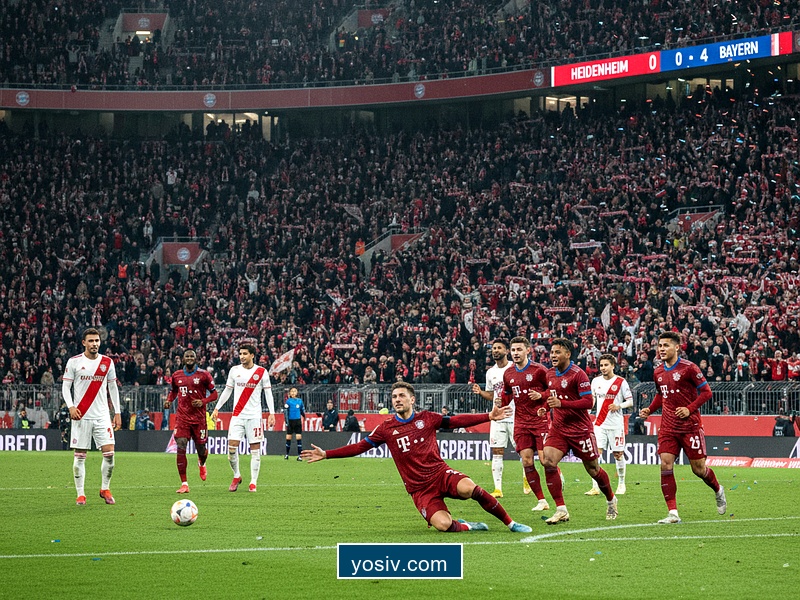
There is a specific kind of silence that falls over the Voith-Arena when the inevitable becomes undeniable. On a freezing Sunday in Heidenheim, we didn't just witness a 4-0 drubbing. We watched the final burial of the "naive" label that has dogged Vincent Kompany since he first walked through the Säbener Straße gates. For eighteen months, critics—myself included—have waited for the high line to snap, for the relentless pressing to leave lungs burning and spaces gaping. We waited for the arrogance of his philosophy to be punished by the pragmatism of the Bundesliga.
We are still waiting.
To understand the magnitude of this result, you must look past the scoreboard. Heidenheim, under the eternal stewardship of Frank Schmidt, is the Bundesliga’s ultimate endurance test. They are the grit in the gears of German football. They exist to frustrate, to bruise, and to capitalize on the vanity of superior teams. Yet, Bayern Munich didn't just beat them; they dismantled the very concept of Schmidt’s low block with the precision of a neurosurgeon and the force of a sledgehammer.
The Death of "Risk-Ball"
When Kompany arrived, the narrative was clear: his Burnley side played beautiful football that got them relegated. The fear was that he would bring a glass cannon to Munich—beautiful to watch, easy to shatter. Early in his tenure, specifically during the erratic defensive displays of late 2024, that fear seemed justified. We saw 9-2 wins followed by inexplicable defensive collapses.
This performance in December 2025 marks the maturity of the project. The "suicidal" high line is no longer a gamble; it is a calculated weapon of mass suffocation. Against Heidenheim, Bayern’s center-backs spent the majority of the match camped 10 yards inside the opposition half. In previous eras, this was anxiety-inducing. Today, it felt routine.
"Possession is not the goal. Possession is the tool we use to ensure the opponent forgets how to breathe." — The unspoken ethos of the 2025 Bayern squad.
The tactical shift lies in the "rest defense." Unlike the chaotic pressing under Hansi Flick, which relied on individual athleticism to recover loose balls, Kompany has instilled a positional discipline reminiscent of Guardiola’s 2014 tenure, but with a sharper vertical edge. When Bayern attacked the Heidenheim box, the structure behind the ball (usually a 2-3 formation) was immaculate. They didn't just stop counter-attacks; they strangled them before the first pass was even made.
The Evolution of the Pivot
We cannot analyze this 4-0 victory without addressing the engine room. For years, the "Holding Six" debate plagued Bavaria like a bad flu. The solution, it turns out, wasn't a 100-million-euro transfer, but the structural evolution of the existing pivot.
The partnership in midfield has ceased to be a duality of attacker and defender. It is now a synchronized unit of space eaters. Against Heidenheim’s physicality, Bayern’s midfield didn't engage in a brawl; they engaged in a keep-away session that demoralized the opposition. The usage of the half-spaces has changed. Instead of the midfielders crashing the box, they are holding the perimeter, recycling play with a tempo that forces the low block to shift left and right until the inevitable fatigue sets in. That is when the gaps appear. That is how you score four goals against a team designed to concede zero.
Historical Context: The Heynckes Comparison
It is dangerous to invoke the spirit of 2013, but the parallels are becoming difficult to ignore. Jupp Heynckes’ treble-winning side was defined not by how they attacked, but by their obsession with not letting the opponent play. That Bayern team didn't just want to win; they wanted to assert dominance.
Kompany has tapped into that specific vein of Bavarian ruthlessness. For a time, under Tuchel and Nagelsmann, Bayern felt like a team trying to solve a puzzle. Under this iteration of Kompany, they are the ones setting the trap. The 4-0 scoreline against Heidenheim mirrors the ruthlessness we saw in the mid-2010s, where away games at difficult grounds were treated as administrative formalities rather than sporting contests.
Tactical Breakdown: The Heidenheim Demolition
| Metric | Tuchel Era (Avg vs Low Block) | Kompany Era (Dec 2025) | Significance |
|---|---|---|---|
| Defensive Line Depth | 45m from goal | 58m from goal | Complete compression of play. |
| Passes Per Defensive Action (PPDA) | 8.5 | 4.2 | Hyper-aggressive immediate retrieval. |
| Possession in Final Third | 35% | 55% | Sustained pressure vs. sterile possession. |
Sustainability: Is the Project Bulletproof?
The skeptic will point to the calendar. It is December. The Bundesliga title is often won in the autumn and lost in the spring. The physical toll of Kompany’s system is undeniably high. We saw signs of burnout in his debut season, where the legs went heavy in April.
However, the rotation management in this match suggests lessons have been learned. The substitutions were not reactive; they were scripted. By killing the game early—leading 3-0 by the 60th minute—Bayern turned a competitive fixture into a training exercise. This ability to "manage" games while maintaining a high line is the holy grail of modern football management. Klopp chased it; Arteta chases it. Kompany seems to have grasped it.
The question isn't whether this works against Heidenheim. We know it does. The question is whether this high-risk, high-reward geometry holds up when Vinicius Jr. or Kylian Mbappé are the ones standing on the halfway line waiting for a mistake. But to worry about the Champions League semi-finals in December is to miss the point of what occurred today.
The Verdict
This 4-0 victory was an autopsy of the old criticisms. It proved that a high line can be secure if the pressure on the ball carrier is absolute. It proved that Bayern can dismantle a physical low block without resorting to crossing aimlessly from the wings.
Vincent Kompany was hired as a project manager, a man to oversee a transition. Somewhere along the line, amidst the doubts and the tactical tinkering, the project ended. The machine is built. It is humming with a terrifying efficiency.
Bayern Munich has stopped playing football matches. They have started executing game plans with a cold, robotic precision that should terrify every other manager in Europe. The "Project" is over. The dynasty has reloaded.