
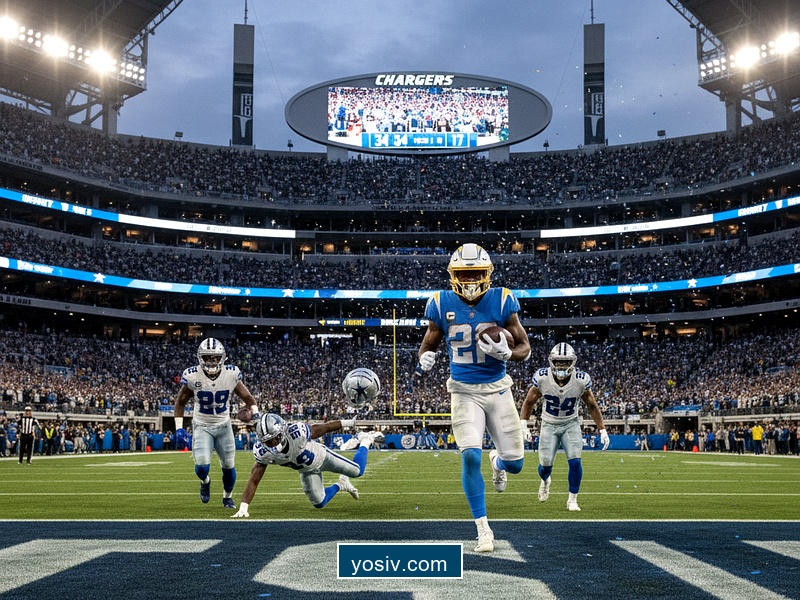
The scoreboard at SoFi Stadium read 34-17, but the numerical deficit doesn't begin to cover the philosophical chasm that opened up between the Los Angeles Chargers and the Dallas Cowboys this past Sunday. As we barrel toward the 2025 postseason, two distinct narratives are crystallizing. One franchise is channeling the spirit of its most dominant, physical ancestors. The other is trapped in a cyclical purgatory, haunted by the specter of legends they can no longer emulate.
To understand why this December 21st matchup felt like a passing of the torch—or perhaps a snuffing of one—we cannot simply look at the box score. We have to look at the ghosts on the sidelines. The Chargers haven't looked this dangerous since the prime of the Marty Schottenheimer era, while Dallas has arguably never looked this defensively toothless since the pre-Parcells dark ages.
The Resurrection of "Martyball" (With a Modern Twist)
The Chargers claiming their fourth consecutive victory isn't just a streak; it’s a stylistic overhaul. For the better part of the last decade, "Chargering" became a verb synonymous with finding creative ways to lose despite having elite quarterback play. The Philip Rivers era, specifically post-2010, was defined by heroic statistical performances undermined by special teams disasters and porous run defense.
What we witnessed Sunday was the antithesis of the "Air Coryell" reliance that has plagued this organization. We saw a return to the physicality of 2006. That year, a 14-2 Chargers squad didn't just beat you; they bludgeoned you. They had LaDainian Tomlinson rushing for 1,815 yards and an NFL-record 31 touchdowns. They controlled the clock and the line of scrimmage.
While the 2025 backfield operates by committee rather than relying on a singular generational talent like LT, the offensive line play is undeniably retro. They mauled the Cowboys' front seven. Justin Herbert, often forced to play hero ball in years past, was efficient, surgical, and protected. This mirrors the role Rivers played in '06—a facilitator of violence rather than a desperate gunslinger. When you can rush for 180+ yards against a desperate Dallas team in December, you aren't just a playoff contender; you are a bully.
"This isn't about finesse anymore. The Chargers have finally realized that in January, the team that hits the hardest usually wins. It took them 20 years to relearn what Marty Schottenheimer knew in his bones."
The DeMarcus Ware Void: A Pass Rush in Crisis
The most damning metric from the Cowboys' defeat wasn't Dak Prescott’s interception count or the time of possession—it was the pressure rate. Or rather, the lack thereof. The official site notes "pass rush struggles" and "personnel changes," which is the polite PR spin for a defensive line that has vanished.
Let’s contextualize this failure. In 2008, the Cowboys finished 9-7, but their defense was a terrifying entity because of one man: DeMarcus Ware. That season, Ware posted 20.0 sacks. He was a one-man wrecking crew who could erase secondary mistakes by forcing the quarterback to evacuate the pocket within 2.5 seconds. Even in the team's lean years, the threat of Ware (and later, a young Micah Parsons) dictated protections.
Against the Chargers, Dallas generated zero fear. Without a consistent edge threat, the Chargers were able to utilize slow-developing crossing routes that shredded the Cowboys' zone coverage. If you cannot rush four and get home in today's NFL, you are dead. Dallas had to manufacture pressure via blitzes, and Herbert, possessing the processing speed of a veteran, simply threw behind the aggressive linebackers. It was a tactical undressing that highlighted how far this unit has fallen from the "Doomsday" standard, or even the Wade Phillips 3-4 aggression.
The December Collapse: A Dallas Tradition
It is almost poetic, in a tragic sense, that this blowout occurred in late December. Comparison to the 2008 season finale is unavoidable. That year, Dallas walked into Philadelphia needing a win to make the playoffs and was annihilated 44-6. The 2025 Cowboys walked into LA needing to prove they were legitimate contenders and left exposed as pretenders.
The issue is identity. The Cowboys have spent the last decade trying to build a high-flying offense to mask defensive deficiencies, reminiscent of the Tony Romo years (2006-2014). But Romo, for all the criticism regarding his "clutch" gene, often elevated mediocre rosters. The current iteration of Dallas feels heavy, burdened by the star on the helmet rather than empowered by it.
Tale of the Tape: The 2006/2008 Standard vs. 2025 Reality
| Metric | 2006 Chargers (Peak Form) | 2025 Chargers (Current Form) | 2008 Cowboys (The Collapse) | 2025 Cowboys (The Reality) |
|---|---|---|---|---|
| Identity | Run-first, Physicality (LT) | Balanced, Trench-dominant | Star-reliant, Chaotic | Pass-heavy, Soft up front |
| Sack Leader | Shawne Merriman (17.0) | Committee Approach | DeMarcus Ware (20.0) | No player over 8.5 |
| Dec. Performance | Undefeated (5-0 in Dec) | Surging (4 straight wins) | 1-3 (Lost win-and-in) | Stumbling toward exit |
| QB Style | Rivers (Efficient/Young) | Herbert (Managed/Elite) | Romo (Gunslinger) | System-dependent |
Why The Chargers Are dangerous (And Dallas Isn't)
The "Takeaways" from the Chargers' media team highlight their playoff viability, and for once, it isn't hyperbole. In the modern NFL, offenses that rely solely on quarterback magic tend to freeze in the playoffs (see: Buffalo in recent years). Teams that can run the ball and stop the run travel well. The Chargers have built a portable operation.
Conversely, Dallas has become a dome team in spirit, regardless of where they play. The "personnel changes" cited in the game recap suggest panic. You don't rotate your secondary in Week 16 unless you are desperate. This smells like the 2013 Cowboys defense that historically allowed 415 yards per game. They are shuffling deck chairs on the Titanic while the iceberg—in this case, the NFC playoff picture—looms large.
The Verdict
Twenty years ago, the Chargers had the best roster in football and wasted it due to undisciplined playoff mistakes (the Marlon McCree fumble remains the cautionary tale). Today, they look like a team that has exorcised those demons through sheer brute force. They are playing 2006 football with 2025 athletes.
Dallas, meanwhile, is stuck chasing the ghost of 1995 while failing to meet the standard of 2008. The 34-17 loss wasn't just a bad afternoon; it was an indictment of a franchise that has forgotten that football, at its core, is still about hitting the man with the ball before he crosses the line to gain. Until Dallas finds their next DeMarcus Ware or Darren Woodson, they are merely highly-paid spectators to the contenders.