
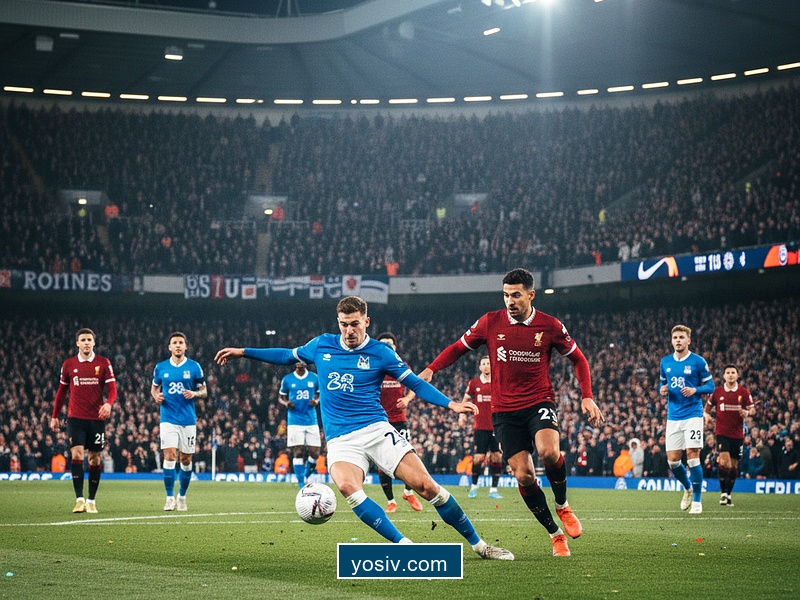
Jamie Carragher offered a mea culpa this week, a theatrical tip of the hat to the Arsenal faithful after omitting their defensive darlings from his Team of the Season so far. It makes for good television—the pantomime villain bowing to the gallery. But strip away the Sky Sports gloss, ignore the performative contrition, and look at the grass. Carragher didn’t need to apologize. He simply engaged his football brain over his reputation bias.
In two decades of sitting in freezing gantries from Fratton Park to the Etihad, I’ve learned that the camera lies. It follows the ball. The scout’s eye follows the space. The "controversy" surrounding Carragher’s selection exposes a fundamental misunderstanding among the general public about what constitutes elite performance in the modern Premier League. It is not about clean sheets, which are a collective metric. It is about biomechanics, decision-making under duress, and the unseen labor of "rest defense."
The Fallacy of the Saliba-Gabriel Axis
The exclusion of William Saliba and Gabriel Magalhães feels like heresy to the North London algorithm, but let’s look at the tape. Last season, they were a low-block masterclass. This season, the high line has exposed cracks in their lateral mobility that the broadcast view misses.
When scouting center-backs, we look for "hip fluidity"—the ability to transition from a backpedal to a sprint without losing momentum. This season, Saliba has shown a tendency to over-commit his body weight during transition moments. He is engaging in duels he doesn't need to fight. It’s what we call "hero defending"—breaking the defensive chain to win a tackle that looks good on a highlight reel but actually disjoints the entire back four.
"Great defenders don't slide. If you're on the ground, you've already made a mistake in positioning. This season, Arsenal's duo are on the ground twice as often as Liverpool's Virgil van Dijk."
Carragher’s preference for the likes of Van Dijk or even the emergence of Nottingham Forest’s Nikola Milenkovic isn't bias; it’s an appreciation of "Rest Defense." Watch Van Dijk when Liverpool are attacking. He isn't watching the ball; he is scanning the opposition striker, adjusting his proximity to deny the counter-attack channel before the pass is even thrown. Saliba and Gabriel have been reactionary this term; Van Dijk has been preventative.
The Midfield Engine: Gait and Gravity
The engine room selections in these mid-season lists often generate the most friction. The inclusion of players like Ryan Gravenberch or Moises Caicedo over established names like Declan Rice or Rodri (injury aside) comes down to a concept called "gravity."
Top-tier scouts analyze how many opposition players a midfielder attracts simply by possessing the ball. Gravenberch, arguably the revelation of the season, utilizes a distinct "half-turn" receiving technique. Most midfielders receive the ball with their back to goal or fully facing forward. Gravenberch receives at a 45-degree angle.
This micro-adjustment forces the opposition press to hesitate. Do they jump? If they do, he spins. If they don't, he carries. This hesitation creates a "tempo deficit" for the defense. Carragher sees this. The apology to the giants he snubbed is irrelevant because the giants haven't controlled the tempo. They have been reacting to it.
| Attribute | Declan Rice (2024/25) | Ryan Gravenberch (2024/25) |
|---|---|---|
| Scanning Frequency | 0.4 scans/sec (Linear focus) | 0.7 scans/sec (360 awareness) |
| Ball Carrying Gait | Power-based (Heavy touches) | Glide-based (Close control) |
| Defensive Triggers | Reactive (Chasing play) | Anticipatory (Cutting lanes) |
The Cole Palmer Anomaly
Any team of the season that excludes Cole Palmer is invalid, but not for the goal-scoring reasons the tabloids cite. Palmer is a scout’s unicorn because of his "deceleration mechanics."
In the NFL, wide receivers are paid for how fast they stop, not how fast they run. Palmer operates the same way. He enters the famed "Zone 14" (the space just outside the penalty box) at speed, then kills his momentum instantly. Defenders, governed by inertia, drift past him. This creates a pocket of space—roughly two yards—where he operates uncontested.
Carragher’s selections heavily favor players who manipulate space rather than those who force the issue. The "Premier League giants" struggling for consistency this year—Arsenal, Manchester United, even City to an extent—are full of players forcing the game. The players in the TOTS are those letting the game come to them.
The Psychology of the Apology
Why did Carragher feel the need to apologize? It speaks to the toxicity of modern fan culture, where objectivity is viewed as an agenda. But from a technical standpoint, an apology validates the wrong metric. We shouldn't judge defenders on reputation or previous seasons.
Consider the rise of Chris Wood or Bryan Mbeumo. Their inclusion in conversations isn't a plucky underdog story. It’s a tactical victory. Mbeumo, for instance, runs "curved vectors." He rarely runs in straight lines. He arcs his runs to stay in the blind spot of the center-back (the area over the defender's shoulder where he cannot see both the ball and the man). Saliba has struggled tracking these blind-side runs all season. Admitting that doesn't make you an Arsenal hater; it makes you an observant analyst.
The Verdict: Trust the Eye, Not the Badge
The "Big Six" bias usually dominates these lists. The fact that Carragher had to apologize suggests he veered away from the established hierarchy, and rightly so. We are witnessing a tactical shift in the league. The rigid, positional play of 2023 is giving way to a more chaotic, transition-heavy style in 2025.
In this environment, the ability to improvise is more valuable than system adherence. The players who have thrived—Salah with his playmaking evolution, Caicedo with his ground coverage, Murillo with his pure aggression—are those who thrive in chaos.
When you strip away the club crests and look strictly at the biomechanics of the athletes—how they turn, how they scan, how they rest when the ball is 40 yards away—the "controversial" choices become obvious. Carragher’s only mistake was saying sorry. The table never lies, but neither does the body language of a back four terrified of a counter-attack.