
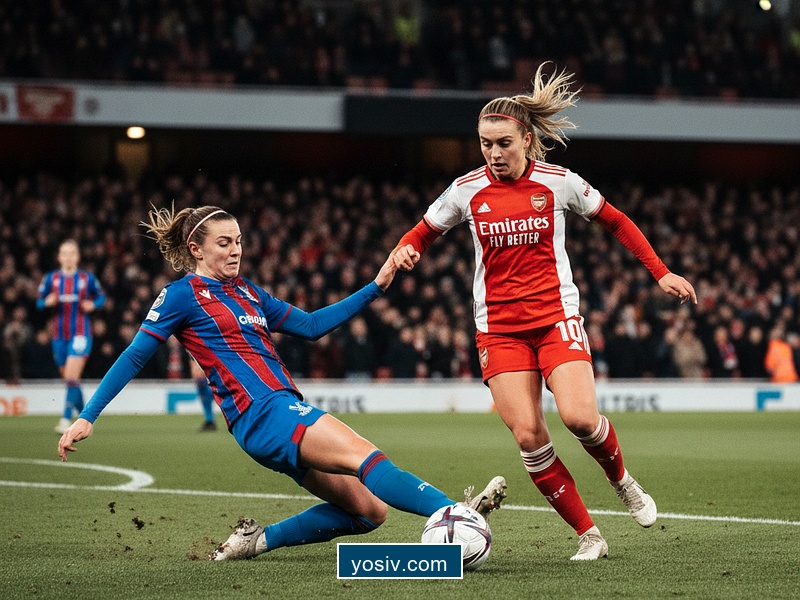
There is a specific sound in football, distinct from the roar of the crowd or the thud of a boot, that defines the elite level. It is the silence of a defensive line that knows exactly what it is doing. Watching Arsenal Women dismantle Crystal Palace 0-2 in the League Cup quarter-final wasn't just about progression to the next round; it was a masterclass in re-establishing a spinal column that has been fractured for too long.
The headline news, naturally, is the return of Leah Williamson to the starting XI. For the casual observer, it is a morale boost. For the professional scout, however, Sunday’s match at Sutton offered a fascinating case study in biomechanics, spatial geometry, and the subtle art of the "quarterback" center-half. To understand why Arsenal looked different against Palace, we have to look away from the ball and focus on the grass behind the play.
The Biomechanics of a Ball-Playing Defender
When scouting a defender returning from an ACL injury, the first focal point is not the tackle; it is the deceleration and the turn. In the warm-ups and the opening ten minutes, Williamson’s body language suggested a player who has moved past the psychological barrier of the injury. There was no hesitation in the planting of the non-kicking foot—a classic "tell" for players lacking confidence in their knee stability.
Against a Palace side that has performed admirably in the Championship, Arsenal needed to navigate a compact mid-block. This is where Williamson’s unique profile changes the mathematical equation of the pitch. Most center-backs receive possession, touch the ball to settle it, look up, and then pass. That process takes approximately 1.5 to 2 seconds.
Williamson scans the field before the ball arrives. By the time possession reaches her feet, she has already mapped the vector of her next pass. In coaching circles, we call this "playing in the future." Against Palace, this eliminated the need for Arsenal’s midfielders to drop deep to collect the ball. Williamson effectively bypassed the first line of pressure simply by manipulating her body shape—opening her hips to suggest a pass to the fullback, only to drill a laser through the center circle.
"The best defenders don't just stop attacks; they start them. Williamson doesn't look at the opposition striker; she looks at the space behind the opposition midfield."
Lotte Wubben-Moy: The Benefit of the 'Stopper-Cover' Dynamic
While the cameras focused on the returning captain, the most improved player on the park might have been Lotte Wubben-Moy. To understand her performance, we must apply the 'Stopper-Cover' theory. For months, Wubben-Moy has had to be the primary ball-progressor and the organizer. That is a heavy cognitive load.
With Williamson back as the 'Cover' (the deeper sweeping presence), Wubben-Moy was released into her natural 'Stopper' role. Her engagement line was fully five yards higher than in previous weeks. Watch the highlights closely: when Palace attempted to transition, Wubben-Moy was stepping into the duel rather than retreating. Her reaction after the game spoke volumes not just of the win, but of the relief of shared responsibility. Her shoulders looked looser; her aggression was calculated rather than desperate.
Tactical Breakdown: The Palace Test
We must credit Crystal Palace. Laura Kaminski has drilled this team well. In the Championship, the gap between the top tier and the second tier is often exaggerated, but physically, Palace matched Arsenal in the duels. The difference was technical execution in the final third.
From a scouting perspective, Arsenal’s dominance was established through "Rest Defense." This is a concept often ignored by pundits. When Arsenal were attacking the Palace box, look at the positioning of Williamson and Wubben-Moy. They weren't spectating. They were actively closing the "negative space"—the areas Palace would look to exploit on a counter.
| Phase of Play | Without Williamson | With Williamson (vs Palace) |
|---|---|---|
| Build Up | U-Shape circulation (side to side) | Vertical penetration (line breaking) |
| Defensive Line | Conservative / Deep Drop | Aggressive High Line |
| Midfield Support | Double Pivot drops deep to help | Single Pivot holds, others push up |
The Unseen Work: Communication and Micro-Movements
Television broadcasts rarely capture the audio required to understand a defense. However, the visual cues of communication were rampant. Williamson operates as an on-pitch metronome. Her pointing is specific—using a flat hand to indicate a zone rather than a finger to indicate a man. This is a crucial distinction in zonal marking systems.
Furthermore, Arsenal’s second goal (and general threat) stemmed from the confidence to commit bodies forward. Because the backline was secure, the wing-backs could invert or overlap without fear. This is the "hidden assist" of a world-class center-back. They don't touch the ball in the final third, but their positioning allows the attackers to stay there.
Historical Context: The Conti Cup DNA
It is vital to contextualize this win within the history of the League Cup. Arsenal are the record holders, the matriarchs of this competition. While other top WSL clubs often treat this tournament as a developmental laboratory, Arsenal view it as a non-negotiable piece of silverware. This mentality was evident in the professionalism of the performance.
In previous seasons under Joe Montemurro or the early Eidevall days, Arsenal occasionally struggled against low blocks in cup ties, forcing reliance on individual brilliance (often Miedema or Mead). Against Palace, the system itself generated the dominance. The 2-0 scoreline flatters the hosts slightly in terms of control, even if Palace fought valiantly. It was surgical. It was patient. It was, dare I say, boring in the most complimentary sense of the word.
The Verdict
This match was not merely a cup tie; it was a calibration exercise for the remainder of the season. The return of Leah Williamson provides Jonas Eidevall with a tactical lever he has been missing. It allows Arsenal to compress the pitch, suffocate opponents in their own half, and sustain attacks for longer durations.
The goals sealed the result, but the victory was constructed in the center circle by a player who hasn't started a match in eons, yet looked as if she’d never left. The scouts in the stands at Sutton would have noted the clean sheet, but they would have underlined the "tempo control" in red ink. Arsenal have their conductor back, and the orchestra is finally playing in tune.