
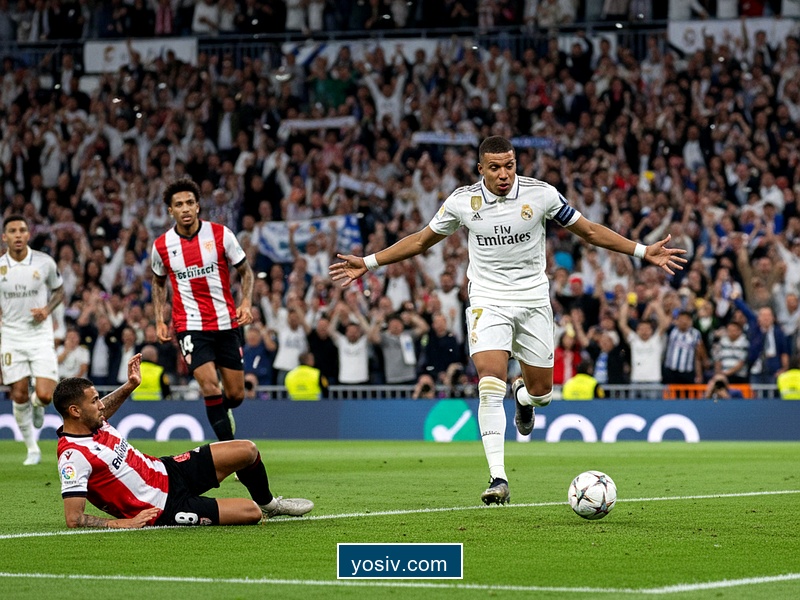
The Santiago Bernabéu has a specific frequency of silence. It usually occurs right before the net ripples, a collective intake of breath from 80,000 souls who know they are witnessing something inevitable. On Saturday night, against a Sevilla side that has historically served as cannon fodder for Real Madrid legends, Kylian Mbappé didn’t just score. He didn’t just secure three points. He reached out across the decade-long chasm of history and high-fived the ghost of Cristiano Ronaldo.
By equaling Ronaldo’s scoring record—a specific benchmark of efficiency in his debut season—Mbappé has officially ended the "adaptation" narrative. But to view this solely through the lens of a spreadsheet is to miss the tectonic shift occurring in the Spanish capital. We are not just watching a great player; we are watching a tactical and spiritual sequel to the 2009-2018 era, but with a plot twist that Carlo Ancelotti has engineered to perfection.
The Statistical Mirror: 2009 vs. 2025
To understand the gravity of what occurred against Sevilla, we must rewind to the autumn of 2009. Manuel Pellegrini was in the dugout, Kaka was the supposed conductor, and Cristiano Ronaldo arrived as a raw, vertical force of nature. Ronaldo’s debut season was defined by a specific kind of violence—long-range missiles, towering headers, and a refusal to pass when a shot was mathematically possible.
Mbappé’s path to this record is fundamentally different, and arguably more sophisticated. Where Ronaldo in 2009 was a soloist playing alongside a team, Mbappé in 2025 is the apex predator in a fluid ecosystem. The goal against Sevilla—a lightning transition involving Jude Bellingham and Vinícius Júnior—showcased a chemistry that took the famous "BBC" (Bale, Benzema, Cristiano) nearly two seasons to fully perfect.
"Ronaldo bludgeoned teams into submission with volume. Mbappé dissects them with surgical movement. The result is the same, but the method is the difference between a sledgehammer and a scalpel."
Tactical Evolution: From the BBC to the BMV
The "Information Age" of football often ignores the eye test, but let’s look at the shape. Ten years ago, under Ancelotti’s first reign and later Zinedine Zidane, Madrid played with a recognized fulcrum: Karim Benzema. Benzema was the oil in the engine, dropping deep to allow Ronaldo to invade the penalty area from the left.
That structure is gone. The current iteration of Real Madrid is playing a brand of "positionless" attack that is terrifying to defend. Against Sevilla, Mbappé rarely stayed central. He rotated with Vinícius on the left and Rodrygo (or Diaz) on the right, creating a tactical headache that Sevilla’s low block couldn't solve with man-marking. This isn't the rigid 4-3-3 of the Mourinho years, built on the low-block counter-attack. This is total fluidity.
Comparative Analysis: The Supporting Cast
| Era | The Engine (Midfield) | The Facilitator | The Finisher | Tactical Identity |
|---|---|---|---|---|
| 2011-2014 | Xabi Alonso / Khedira | Mesut Özil / Benzema | Cristiano Ronaldo | Vertical Counter-Attack |
| 2024-2025 | Valverde / Camavinga | Jude Bellingham | Kylian Mbappé | Rotational Fluidity |
The key difference lies in the midfield. Xabi Alonso and Sami Khedira provided a static base for Ronaldo. Today, Federico Valverde and Eduardo Camavinga offer a dynamism that allows Mbappé to cheat defensively—much like Ronaldo did—without compromising the team's structure. The team presses higher and recovers the ball faster than any version of the Galácticos from the early 2000s ever could.
Sevilla: The Litmus Test of Legends
There is a poetic justice in this record being equaled against Sevilla. For seasoned La Liga watchers, Sevilla has always been the yardstick for Real Madrid’s forwards. Between 2011 and 2015, Ronaldo terrorized the Andalusians, scoring more goals against them than any other club. He notably scored four hat-tricks against Sevilla in his time in Spain.
However, the Sevilla of 2025 is a different beast than the naive, high-line defenses managed by Unai Emery a decade ago. Modern La Liga defenses are compact, cynical, and technically sound. For Mbappé to match Ronaldo’s output in a league that has statistically become lower-scoring and more tactically rigid is a testament to his adaptability. He isn't farming goals in a chaotic league; he is unlocking vaults.
The Weight of the Shirt
We must address the psychological component. Many have tried to fill the void left by Ronaldo. Eden Hazard arrived with the talent but lacked the durability. Gareth Bale had the moments but lacked the consistency. Mbappé has arrived with the arrogance—the necessary arrogance—to demand the ball and the spotlight.
Watching him point to the badge after the goal, one couldn't help but recall the Calma, Calma celebrations of 2012 at the Camp Nou. There is a lineage here. Real Madrid does not tolerate humility well. They require a protagonist who believes they are bigger than the game itself. Mbappé, free from the shackles of Parisian politics, has finally found a stage large enough for his ego.
The Verdict: Better than the Original?
Is this blasphemy? Perhaps. But consider the trajectory. Ronaldo arrived in Madrid at 24, with a Ballon d'Or already in his cabinet. Mbappé has arrived at a similar peak age, but with a World Cup title and nearly a decade of top-flight dominance under his belt.
The scary reality for Barcelona and Atletico Madrid is that Mbappé is currently operating at about 80% efficiency. He is still learning where Bellingham likes to release the pass; he is still syncing his runs with Vinícius’s dribbles. Ronaldo’s 2009/10 season ended with 33 goals in 35 games, yet Madrid went trophyless. This current squad is built to ensure that Mbappé’s goals translate directly to silverware.
Equaling the record against Sevilla is a nice headline. It keeps the statisticians employed. But the real story is that the Bernabéu has finally stopped looking backward. For seven years, the shadow of CR7 loomed over every forward who missed a sitter or failed to track back. That shadow has finally dissipated. It has been replaced by a turtle who runs like a cheetah and finishes like a king.